A duty cycle rating is a percentage of 10 minutes at a specific amperage: divide by 10 for the minutes of welding before the machine needs to cool. Compare machines at the amps you'll use, not at their peak, and remember that a rating at a higher current is a stronger claim than the same percentage at a lower one.
The definition
Miller defines duty cycle as a percentage over a 10-minute period: divide the percentage by 10 for the number of minutes the machine can operate before it needs to cool down. Its example is a machine rated 30% at 215 amps on 240 volts, which allows about three minutes of continuous welding at that output. Miller adds that extended use past the duty cycle can cause the machine to malfunction or overheat.
Most modern machines protect themselves with a thermal overload that stops the arc until the machine cools. That's an annoyance in the middle of a long bead, not a disaster, but a machine that trips constantly is the wrong size for the work.
Why it's always tied to amps
Heat in a welder's transformer or inverter rises with current, so the same machine can run a larger share of time at lower output. That's why makers state duty cycle with an amperage, and why many list two or three points, such as 20% at 140 A and 60% at 80 A. A duty cycle without an amperage tells you nothing.
Makers choose the point they print. One may quote its duty cycle at full output, another at a modest current where the percentage looks larger. To compare fairly, find each machine's rating at the current you'll actually use, or the nearest stated point above it.
Reading ratings side by side
| Machine | Output (maker) | Duty cycle (maker) |
|---|---|---|
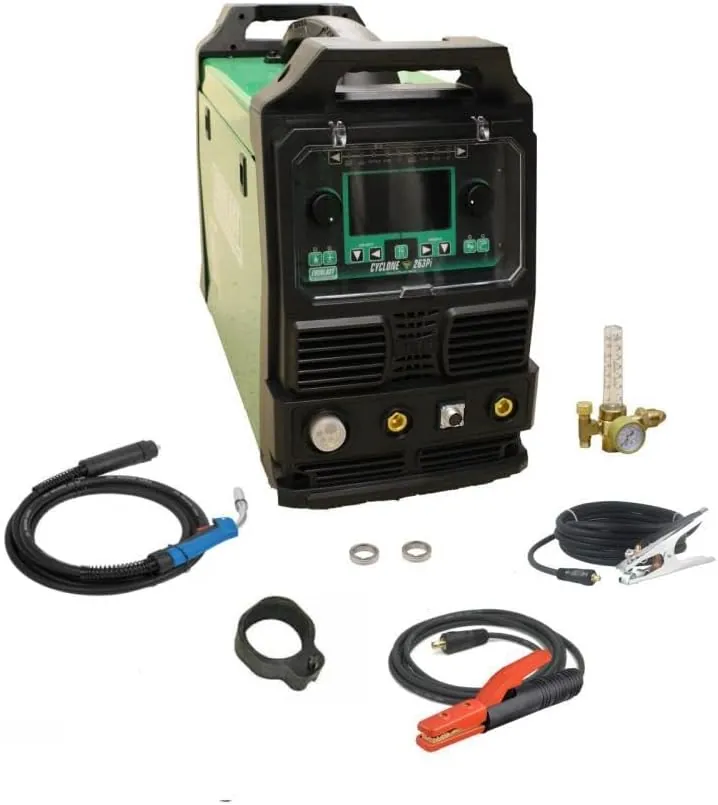
| Everlast CYCLONE 312i MIG Welder | 315a | 35% at 315A, 60% at 250A |
A rating of 30% at 200 A means more working time at 150 A than a rating of 30% at 120 A does, even though the percentages match. When two machines are rated at different currents, compare at the higher current, using only what each maker states.
How much duty cycle you need
| Duty cycle | Welding | Cooling |
|---|---|---|
| 20% | 2 minutes | 8 minutes |
| 30% | 3 minutes | 7 minutes |
| 40% | 4 minutes | 6 minutes |
| 60% | 6 minutes | 4 minutes |
| 100% | 10 minutes | none |
Most home and farm welding is tacks, short beads and fitting between welds, so the arc is lit far less than half the time. A long fillet down a trailer rail, filling a spool of hardfacing, or production work on a bench are where duty cycle starts to bite. If you weld at the machine's limit for long runs, look for a rating of 40% or more at your amps.
Things that lower real-world duty cycle
- Ambient heat: ratings are made at a set temperature, and a hot summer garage gives less working time.
- Blocked airflow: a machine pushed against a wall or buried under clutter cools slowly.
- Long extension cords on 120-volt machines, which drop voltage and make the machine work harder.
- Running near the top of the output range for every bead.
A worked example
You'll MIG weld 1/8-inch steel at about 125 amps (Miller's 1 amp per 0.001 inch rule) and want to run a 4-minute bead. That's a 40% duty cycle at 125 A or more. A machine stated as 20% at 140 A doesn't reach it on its stated points; one stated as 40% at 150 A does. Our duty cycle calculator runs the same check against every machine's stated ratings.